Peirspicacity

Self is arrayed as the whole world.
— Dogen, Uji (Cleary 1986, 345)

What you are aware of, mindful with, is the entire universe, as far as you are presently concerned. Can you point out one thing in the universe that you are not aware of?

No, but you can surely think of things or events that you became aware of, things that surely existed before you were aware of them, events that you did not foresee, places you have never been, situations that did not concern you at the time.

So you are aware that there is more to the universe than you are now aware of, or will ever be aware of. You also know that some of your beliefs about it have turned out to be wrong, which leads you to believe that some of what you now “know” may also be wrong. The universe of your awareness is infinitely incomplete. Does that concern you?

Charles S. Peirce was thinking along these lines in 1913, a few months before his death, when he wrote that

what I am aware of, or, to use a different expression for the same fact, what I am conscious of, or, as the psychologists strangely talk, the “contents of my consciousness” (just as if what I am conscious of and the fact that I am conscious were two different facts, and as if the one were inside the other), this same fact, I say, however it be worded, is evidently the entire universe, so far as I am concerned. At least, so it would seem. Yet there is a wonderful revelation for me in the phenomenon of my sometimes becoming conscious that I have been in error, which at once shows me that if there can be no universe, as far as I am concerned, except the universe I am aware of, still there are differences in awareness. I become aware that though “universe” and “awareness” are one and the same thing, yet somehow the universe will go on in some definite fashion after I am dead and gone, whether I shall be the least aware of it, or not.
— Peirce, EP2:472
Life flows on within you and without you.
— George Harrison, 1967

Charles Peirce and George Harrison are both dead and gone now, and life flows on without them. It flows within you too, the little current of awareness, the entire universe as far as you are concerned, but a drop in the Big Current of Okeanos. The bubble of what you know embodies your concerns, and though it’s only made of surface tension, there’s no getting out of it while you live. At best you can take in the odd bit from beyond the barrier to make it a little bigger.

Peirce was thinking about this too toward the end of his life:

… I was many years ago led to define “real” as meaning being such as it is, no matter how you, or, I, or any man or definite collection of men may think it to be; where I use the long and awkward phrase in order to avoid all appearance ​of meaning ​independently of human thought. For obviously, nothing that I or anybody ever can mean can be independent of human thought. That is real which men would eventually and finally come to think to be absolutely necessary to be thought in order to understand the truth, supposing the existence and advance in knowledge of the human race to be continued without any limitation, though I cannot pretend that I have as distinct an idea of exactly what that means as I could wish. But, alas, there seems to be a principle as inexorable as that of action and reaction condemning those creatures who enjoy the privilege of perpetually learning to find their outlook forever confined within a sharply drawn horizon, a confinement the more exasperating for the fact that they have only to exert themselves sufficiently in order to enlarge it while leaving it still a prison-wall.
— Peirce (R 681: 35–36, 1913) quoted by Lane (2018, 193-4)

What does it mean to suppose ‘the existence and advance in knowledge of the human race to be continued without any limitation’? Certainly not to believe that human life will never end, or that human knowledge will be forever advancing. It means to imagine what it would take for humans to finally ‘understand the truth,’ knowing the finality to be imaginary.

As for the little current, what does it mean to suppose you’ve been selected for a secret mission? It means to imagine that your life has a definite purpose. Why would you do that?

Collapse and renewal

We’re all wondering how many of us will survive the coronavirus pandemic, but in the longer term, many of us are wondering what remnants of our globalized civilization are likely to survive the collapse that is now under way.

In her 2015 book The Mushroom at the End of the World, anthropologist Anna Tsing addresses the question in her subtitle: on the possibility of life in capitalist ruins. Those “ruins,” by the way, should be pictured not as crumbling buildings like the “ruins” of ancient civilizations, but as the ecosystems that have been systematically ruined by extractive capitalism.

Jeremy Lent also raised the question last fall on his Patterns of Meaning blog, ‘As Society Unravels, the Future Is Up for Grabs’. Here he applies the concept of “the adaptive cycle” to human society.

Scientists have studied the life cycles of all kinds of complex systems—ranging in size from single cells to vast ecosystems, and back in time all the way to earlier mass extinctions—and have derived a general theory of change called the Adaptive Cycle model. This model works equally well for human systems such as industries, markets, and societies. As a rule, complex systems pass through a life cycle consisting of four phases: a rapid growth phase when those employing innovative strategies can exploit new opportunities; a more stable conservation phase, dominated by long-established relationships that gradually become increasingly brittle and resistant to change; a release phase, which might be a collapse, characterized by chaos and uncertainty; and finally, a reorganization phase during which small, seemingly insignificant forces can drastically change the future of the new cycle.

As many other commentators are saying, the shaping of our “recovery” from the pandemic is an opportunity to change the future of the new cycle of civilization. It is clear that many of the people and subsystems of the now-collapsing global system are not going to survive, but chances are we can have some influence on how it all turns out. For more on this cyclical pattern, including diagrams of it and my own reflections on it, visit rePatch ·11 of Turning Signs.

Gut feelings

In the early stages of writing my book Turning Signs, i was very strongly moved by the realization that the world is inside out – that the whole of your experience of the world is something going on in your brain. This activity is taking place at the cellular and subcellular levels, and not until the 20th Century was it possible to investigate in detail how these microcosmic processes actually work to generate our thoughts and feelings. More recently we are learning that the brain is only part of this microcosm.

At the same time, we have been developing the technology to explore the macrocosm, the vast reaches of the physical universe. This development began 400 years ago with the first telescope, but it was only 100 years ago that we recognized the existence of other galaxies far beyond our own. Our knowledge, our cognitive universe, has been expanding both inwards and outwards toward the micro- and macroscopic limits of our augmented perception. Our comprehension of time has also expanded in scale, in both directions: we have begun to appreciate how much can happen in a millisecond, and how long it takes the light from a distant galaxy to reach us. Our moment in cosmic time is marked by a wonderful flowering of the imagination.

Returning to the microscopic scale, this excerpt from a recent Science magazine article is a good example of that flowering:

Over the past 20 years, the recognition that the microbes living inside us outnumber our body’s own cells has turned our view of ourselves inside out. The gut microbiome, as it’s known, weighs about 2 kilograms— more than the 1.4-kilogram human brain— and may have just as much influence over our bodies. Thousands of species of microbes (not only bacteria but also viruses, fungi, and archaea) reside in the gut. And with as many as 20 million genes among them, those microbes pack a genomic punch that our measly 20,000 genes can’t match. Gut bacteria can make and use nutrients and other molecules in ways the human body can’t— a tantalizing source of new therapies.

The brain is the newest frontier, but it’s one with an old connection to the gut. The ancient Greeks, for example, believed mental disorders arose when the digestive tract produced too much black bile. And long before microbes were discovered, some philosophers and physicians argued that the brain and gut were partners in shaping human behavior. “What probably happens is that our brain and our gut are in constant communication,” says [John] Cryan, who over the past decade has helped drive efforts to decode those communications.

—Elizabeth Pennisi, “Meet the Psychobiome” (Science, 8 May 2020, Vol. 368 Issue 6491, p. 571)

John Cryan is a neuropharmacologist at University College Cork. He and a psychiatrist colleague, Ted Dinan, coined the term “psychobiotics” for the new field of research into microbe-based treatments for mental illnesses. No doubt this research is being funded by an industry hoping for profits down the road, but it contributes nonetheless to the flowering of imagination that “has turned our view of ourselves inside out.” In 2020, the virus which has turned our daily lives upside down should only add to our respect for life at the micro-scale and its effect on our human-scale lives.

On the other hand, our growing ability to conceive of (and measure) vast differences of scale in space and time is still rooted in the human scale of experiencing. We know much more about past events than we do about the future, but the past is no more present to us than the future. What is present to us is the remains of the past, the traces of what’s happened, the signs we can read in order to imagine our planet’s history with some degree of accuracy. In the same way, by reading what is present to us and puzzling out some reasons why it is the way it is, we imagine the future with some degree of plausibility.

Our ability to imagine the deep-time context of the present moment enables us to feel its presence all the more deeply. That’s the gift of this brief moment in the history of the universe. But our acceptance of this gift, our experience of it, seems to depend on the myriads of microbes inhabiting the psychobiome. We begin to see with our high-power microscopes how much of our mental life we owe to gut feelings.

thought for Earth Day

Every living thing on Earth plays a part in the biosphere.

The biosphere is not merely the stage on which we all perform; it is the whole performance.

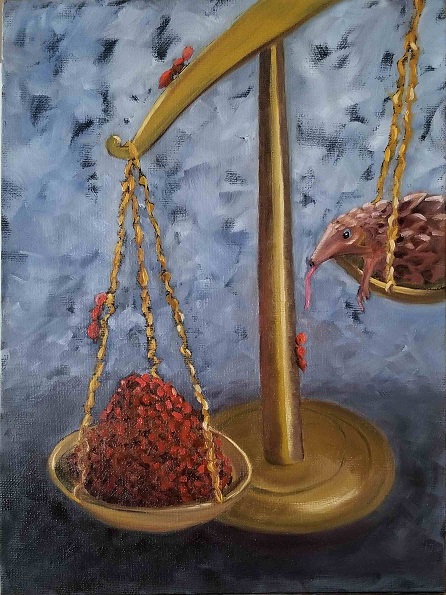
A fascinating kind of anteater called the pangolin is the only mammal on Earth that has scales. Its scales are its only defense against predators. Unfortunately this defense is useless against the dominant predator on Earth, humankind. (Or as e.e. cummings called it, ‘this busy monster, manunkind.’)

In a human-dominated world, the pangolin’s scales are even worse than useless for its survival, because they have a high “market value,” meaning that too many humans “make a living” supplying that market.

Humans have scales too, but only artificial ones, often used for weighing things that have “market value” – such as pangolin scales. In the gigantically top-heavy artificial monster called “the economy” by its human constructors, pangolin scales far outweigh the lives of pangolins, just as “market value” outweighs the value of life itself, including human life.

Pam Jackson has caught the whole strange scenario in a small painting:

Scales

This has a special meaning on Earth Day 2020, as it’s been suggested that the pangolin might have been a carrier of the virus that jumped to humans to cause the COVID-19 pandemic. The pangolin – poached, trafficked and endangered – is as innocent as the virus itself. If anyone is to blame for the pandemic, it is the humans who “make a living” from an extractive “economy” which is destructive, on an overwhelming scale, to other players in the biosphere. The pandemic is just one symptom of the busy monster in self-destruct mode.

Earth Day should redirect our attention to the natural economy, the economy of the biosphere. As if our lives depended on it – for in truth they do, just like the lives of pangolins, ants and viruses.

Nostalgia for the 21st Century

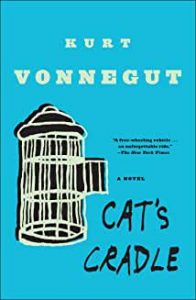
If i may shamelessly lift a few lines from the last rites of the Bokononist faith:

God made mud.
God said to some of the mud, ‘Sit up!’
‘See all I’ve made,’ said God, ‘the hills, the sea, the sky, the stars.’
And I was some of the mud that got to sit up and look around.
Lucky me, lucky mud.

The mud of the 21st Century had truly wonderful means of looking around. If you never heard of the Bokononist faith, for instance, you could just “google” it and read all about it. Or type the keywords into some other search engine, if you didn’t trust Google’s algorithms to properly rank the results.

You didn’t have to fly anywhere to witness nature’s most amazing events. The BBC Earth crews did the flying, and the patiently waiting for the wildlife to do something interesting, so you could see it all in high-def, time-lapse and slow motion. You could even see a picture of the supermassive black hole at the centre of a distant galaxy, taken with a radiotelescope array the size of the Earth.

Meanwhile, other species of mud living on the same planet were swallowed up in mass extinction – the sixth in the planet’s history, but the first caused by a single species. That peculiar form of mud even had the means to look into its own past and see where it went wrong, and what a more sensible species could do on behalf of all mudkind. It had the means to wonder whether it would ever wake up from its busy, busy sleepwalk.

Electric realism

William Rees, co-inventor of the ecological footprint concept, recently published an article entitled ‘Don’t call me a pessimist on climate change, I am a realist.’ He outlines all the reasons why it is unlikely that humanity will achieve the transition to a just, healthy and sustainable way of occupying our planet. I’m inclined to agree with him on that. So i hope readers don’t think i’m an optimist on climate change just because i’m writing about ‘the transition’ and doing what little i can to further it. I’m not an optimist on living forever, either, but that only encourages me to live more deeply the little time i have.

The same applies to human civilization, as far as i’m concerned. If we are in the process of destroying ourselves, i’d really like to understand what it is about human-nature relations that pushes us in that direction. If we are in the process of making the transition to a civilization that respects the nature of ecosystems, i’d like to understand that too. Or at least contribute to somebody else’s understanding by reporting on our local experiments.

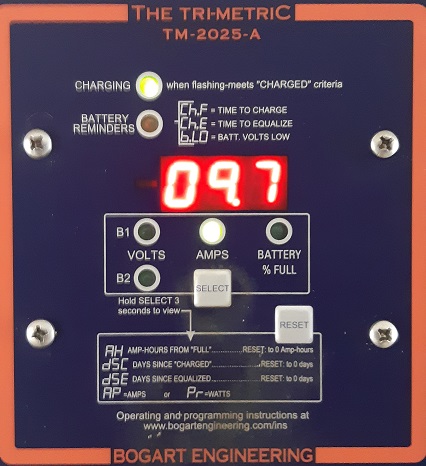
This meter in our kitchen is how we keep track of our solar energy supply. This Monday morning at 11 a.m. we have 9.7 amps more coming in than we are using.

One of those is our Chevy Bolt EV. Electric cars face special challenges in winter, because cold batteries don’t operate as efficiently. We do have an enclosed garage, but it’s not heated. The manual for ours recommends keeping it plugged in when temperatures fall below freezing. We can’t do that because we’re off the power grid and keeping the car plugged in would very quickly drain the batteries that power the whole house. To give you a rough idea, we need about 5 kilowatt-hours per day to power the household – more in the November-to-February stretch because the nights are longer. On an uncloudy day we can draw that much from the sun in 3 hours or less; but uncloudy days are rare this time of year, and 5 kwh will only power the car for about half an hour’s driving.

Of course we can’t just let the car sit unused for weeks at a time either. Since the cold weather started, Pam has been out driving three or four times a week. One weekly trip includes a charging session using the Level 2 charger we installed at our on-grid place in Little Current (15 km from home). She’s found that we can save energy by using the heated driver’s seat and steering wheel rather than heating the whole interior of the car. Of course we need the windshield defroster occasionally – but not very often (unless there’s too much conversation going on among passengers and driver!). Anyway, the risks of relying on an EV in winter are greatly outweighed by the benefits of low maintenance, zero emissions and very low “fuel” costs. We’ll see what happens when the temperature drops to -25 C.

November propanity

Remembrance Day is a good time to honor those who sacrificed so much in those 20th-century wars. It’s also a good time to reflect on our national and personal contributions to the 21st-century war against global heating.

Canada is lagging behind most other G20 countries in this respect, according to the latest Brown to Green Report from the Climate Transparency network. Part of the purpose of this blog is to help subscribers keep track of how the “Brown to Green” transition is going on the planetary scale – but in this post i’d like to focus more on our own household.

I should mention first that in my personal approach to “the transition,” i’m not trying to change the world. I am simply recognizing that the world is changing, that the impact of human actions on the ecosystem is increasing rapidly, and that my own actions affect that impact. So i am changing the world whether i like it or not. The fact that our household choices are too small to register on the global scale makes no difference on the psychological or spiritual level, if i may call it that. The life of the spirit is its presence to the moment we are living, and that moment is independent of scale. The Big Bang happened yesterday, and i started writing this paragraph eons ago. The time is now, as always.

So today i’m writing about propane, the one fossil fuel we rely on directly here at gnusystems. It’s relatively clean as fossil fuels go, but burning it still emits greenhouse gases, so we try to minimize our use of it. Our main year-round use is cooking. We made that choice because using electrical heating elements to cook is not practical for an off-grid solar-powered house, and cooking with a woodstove is not practical either for our situation. We do heat the house with a woodstove, but ours isn’t suitable for cooking.

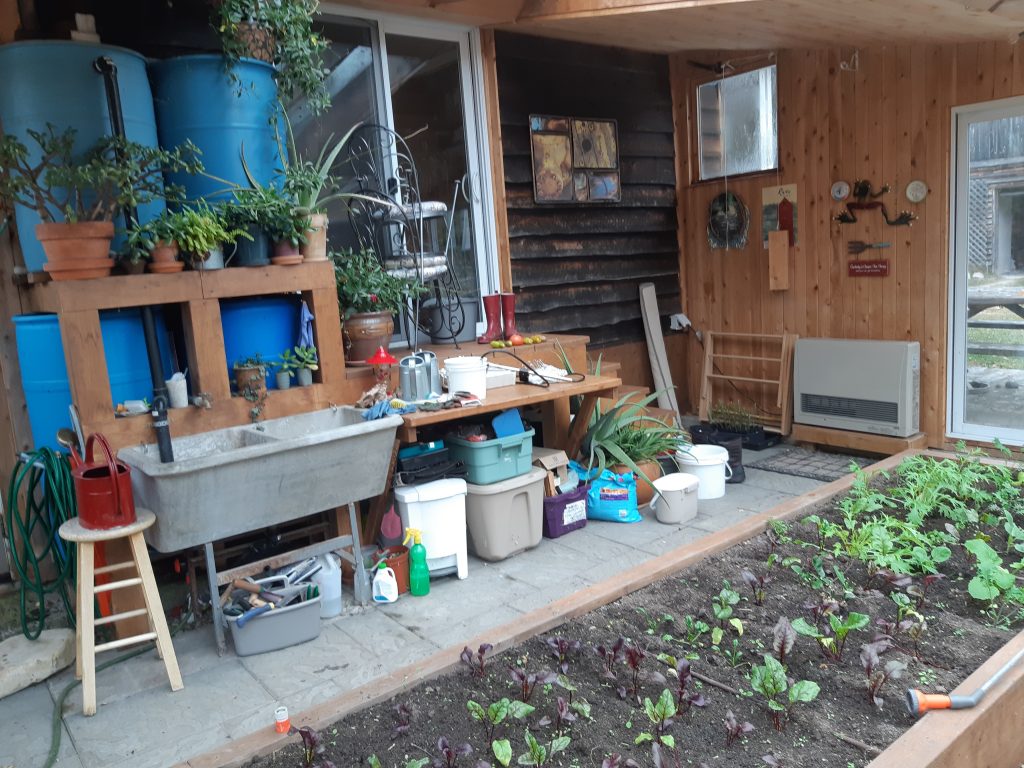
Now that we are entering the darkest and coldest part of the year, we start using much more propane. We use a propane wall furnace to keep the plants in our greenhouse from freezing. In the picture, you can see it on the right, next to the sliding door to the outside. I just plugged it in today (it uses electrical power to light the flame and run the fan) because it was -10° C. outside this morning. But i’m hoping that this year i won’t have to leave it plugged in all winter.

We have it at the lowest possible setting, which is 5°, but when it’s running it actually keeps the temperature in there at 10°. But since the greenhouse is attached to our main house, there should be days, even in winter, when the added heat from the sun is enough to keep it above freezing. So i’m experimenting with shutting off that heater on some days, in order to reduce the amount of propane we use.

Our other main use of propane in winter is to fuel the generator which charges up our batteries on days when there’s not enough sun to do it. We’ve also taken steps to reduce propane consumption there too, by adding more solar panels this fall and increasing our battery capacity a couple of years ago. The more power we can get directly from the sun, and the more of it we can store, the less we have to rely on fossil fuels. We’ll see how these experiments go.

I don’t want to leave the impression that keeping track of our household energy consumption is an onerous chore, or a “sacrifice” we are making. On the contrary, knowing intimately where our food, water, energy and connectivity is coming from is one of the best features of living so far from the city. It’s our idea of a good time, infinitely more than flying down to Rio or the south of France for the winter. Of course we love the peace and quiet too …

Next time i’ll report on how our electric car is handling the onset of winter (another experiment in eco-living).

Databiz exposed

Last week i posted my reasons for dumping my Facebook account. Today’s National Observer has a report on the work of the International Grand Committee on Disinformation and Fake News which gives some further insight into the workings of Facebook and other social media giants.

Canadian businessman Jim Balsillie was among those who addressed the Committee about major Silicon Valley firms and the way they exploit customers: “The current business model is the root cause of the problems you are trying to address​​​​. Its toxicity is unrelenting. It is not a coding glitch that a legal patch will fix. Data at the micro-personal level gives technology unprecedented power and that’s why data is not the new oil — it’s the new plutonium.”

A transition to greater climate justice will depend on reining in the political power of Big Oil, but it may also require reining in the power of Big Data.

EarthTypes

Some time ago I included here a couple of quotes from David Grinspoon’s book Earth in Human Hands: Shaping Our Planet’s Future. Since then it’s become even more obvious that we (humans) are faced with the ‘fundamental Anthropocene dilemma … that we have achieved global impact but have no mechanisms for global self-control’ (Grinspoon). Is global self-control even possible for us? Can we even manage to compensate for some of the damage we’ve already done? What would it take to achieve that?

I think humanity as a whole would have to start thinking like a planet, becoming an instrument by which planet Earth can achieve a measure of its own self-control. This means learning to recognize the patterns which govern the life of the planet, and conforming the habits of our species to the habits of nature.
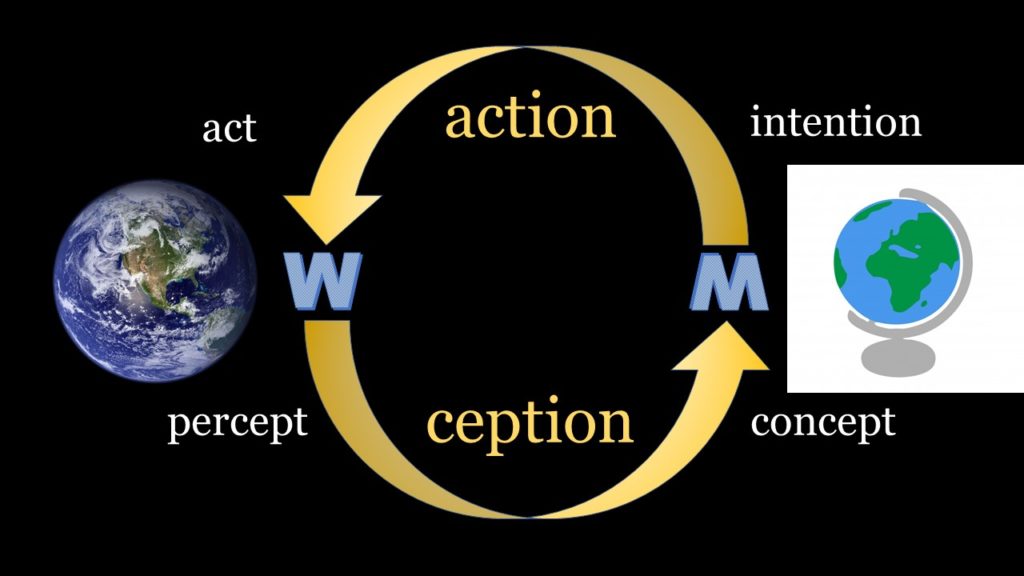

Like Gregory Bateson’s Mind and Nature (1979), Turning Signs is an attempt to delineate some of the ‘patterns that connect’ our thoughts with those of Nature – or of the Creator, the animating spirit of the universe. One of those patterns I call the ‘meaning cycle’. Sometimes the evolution of meaning of a single word follows this pattern. Take the word type. (For a concise view of its etymology, see the Online Etymological Dictionary.)

The ancient Greek word τύπος, in its earliest uses, referred to a “blow,” such as a sword against a shield. Later it referred to the dent or impression made by such a blow, or an imprint such as a footprint. Plato used it in reference to a mark on something, such as a letter written on a page. It could also refer to “anything wrought of metal or stone,” or more generally, a “figure, image or statue” (LSG) – a definite or static form made on or in some relatively permanent medium. Still more generally, it could mean the “general form or character of a thing” (LSG). These later senses migrated to Latin typus: “figure, image, form, kind.”

Already there is an ambiguity here, which we also find in English uses of the word. Most of us would agree that a bird is a type of animal. In other words, we recognize the class of animals as a very broad one which includes among its subclasses one called birds; but we also recognize that there are many subclasses or types of birds. So there is a hierarchy of generality, and animal is a more general term than bird. Yet bird is still a general term: it applies to all existing birds (as well as imaginary ones). As a type, or “form”, bird does not exist. That type is real, because it is really true to say that all existing birds are birds and not something else. There is a real connection between the existing individual being and the real form we call bird. But there is a crucial difference between the reality of types and the reality of existing things. This difference can create ambiguity whenever we use a general term.

Now suppose I ask you to imagine or visualize a bird. The image that comes to mind will probably (though vaguely) resemble whatever species of birds are most common in your everyday environment; and probably it will not resemble an ostrich or a penguin. We don’t think of these as typical birds, although they certainly belong to that biological class. Your concept of bird, then, is not an exact location in meaning space but a region with a centre and a periphery – both vaguely defined, but some birds appear closer to the centre than others. So your image (or “impression”) of a typical bird is more specific than the class of birds.

In the Oxford English Dictionary, the first meaning given under type is ‘that by which something is symbolized or figured; a symbol, emblem.’ In 19th-century English, the word “type” often referred to a specific image which seemed typical of something, or an individual specimen belonging to a class which served as a “model” for the whole class.

For a more visual presentation of all this, I’ve created a slideshow which you can view as a PDF here. But to continue verbally with the evolution of “type”:

In the early 18th century, type came into use for blocks of metal or wood with letters or characters carved on their faces for use in the printing process. So the meaning had moved from the striking of a blow to the impression made by the blow to the thing that made the impression, on paper or some other material. If you’re old enough to have used a typewriter, you remember using a keyboard to strike blows on paper and print letters on it. Nowadays keyboarding makes letterforms on a screen, but we still call those forms “typefaces” or “fonts,” both terms that originated in the printing process.

In an 1843 book on logic, John Stuart Mill wrote that

when we see a creature resembling an animal, we compare it with our general conception of an animal; and if it agrees with that general conception, we include it in the class. The conception becomes the type of comparison.

Since then, most uses of the word type have become pretty much synonymous with “kind” or “class,” and we no longer use it in reference to a typical but existing member of the class. We can no longer say that a robin is “the type” of all birds, although we can say that a robin is a prototypical example of the concept bird. So “type” now refers to a general rather than a specific “something.”

A common noun or adjective is always general to some degree, meaning that it can be applied to a range of individuals (who may differ in other respects but share the named character). In that sense every common noun is the name of a type. But here again there is ambiguity, because a general sign may be used collectively (referring to the type or class as a whole), or distributively (so that it refers to every individual of that type).
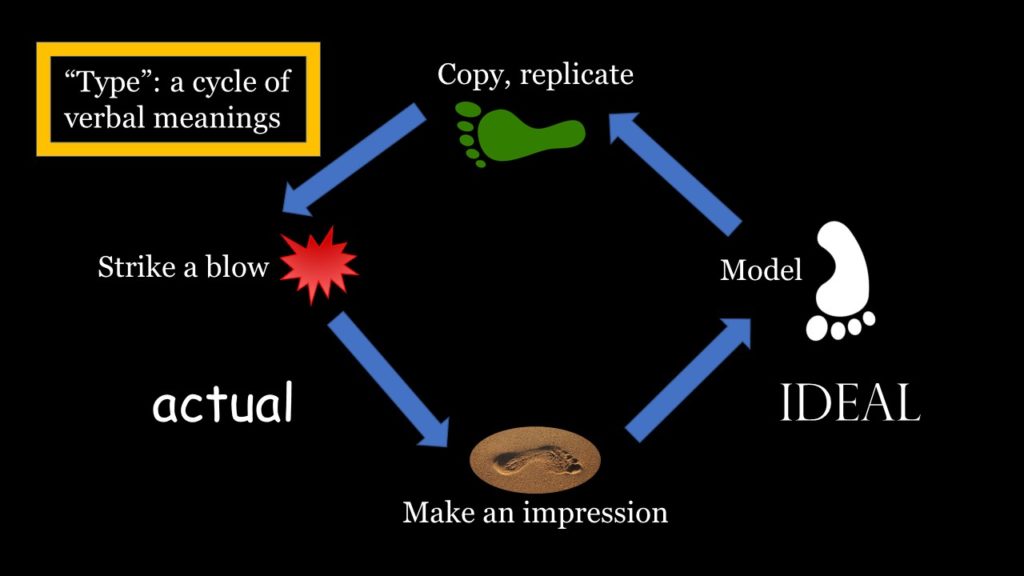

Charles S. Peirce used the word ‘type’ in most of the senses above, but he also adapted it for use as a technical term in semiotics for a different kind of generality. Here is his explanation (also given in Chapter 2 of Turning Signs):

A common mode of estimating the amount of matter in a MS. or printed book is to count the number of words. There will ordinarily be about twenty the’s on a page, and of course they count as twenty words. In another sense of the word “word,” however, there is but one word “the” in the English language; and it is impossible that this word should lie visibly on a page or be heard in any voice, for the reason that it is not a Single thing or Single event. It does not exist; it only determines things that do exist. Such a definitely significant Form, I propose to term a Type. A Single event which happens once and whose identity is limited to that one happening or a Single object or thing which is in some single place at any one instant of time, such event or thing being significant only as occurring just when and where it does, such as this or that word on a single line of a single page of a single copy of a book, I will venture to call a Token.

— Peirce, CP 4.537 (1906)

By clearly distinguishing it from a Token, which is an existing thing or actual event, Peirce brought another dimension of generality to the meaning of the word Type. It is not only a class-name but ‘a definitely significant Form’ which does not exist as an individual, or even as a singular collection, but ‘determines things that do exist.’ Taking his example of the word “the,” each existing imprint or Token of that word on a printed page is determined by its Type to take the visible form which makes it an instance of that significant Form. A Type which can really determine things that do exist even though it does not exist is another kind of reality. If we can understand how Types determine Tokens, we can clearly see that there is more to reality than existence.

Applying this to human language, we can say with Wittgenstein that what makes the Form of a Type significant is its use in the language. For instance, the language-user’s syntactic habits may determine that the Form is required as part of a given statement; then another semiotic habit determines what sound the speaker will produce at that point in her utterance – or yet another habit which associates that Form with certain visible shapes on the printed page determines what will appear in that part of the printed sentence. The shapes of the letters will be still more precisely determined by the choice of font or typeface in which the text is printed. But the word, as far as its meaning is concerned, is the same word regardless of typeface, and likewise regardless of whether it is printed or spoken. In other words, that word is a real Type in Peirce’s exact sense of the word.

The habits which govern our acts of meaning are partly artificial and partly natural. The natural habits of meaning are also habits of the Earth, embodied in the actual behavior of earthlings like us. Those are the habits which make it possible to learn from experience, while our conventional linguistic habits make it possible to symbolize what we learn, so that we can take some control of our own habits. If we can somehow synchronize our collective habits with the habits of the Earth (or of Gaia, if you like), then eventually the Earth can use us to develop a measure of self-control, to better determine its own future. This is the challenge of the Anthropocene. Turning Signs is one attempt to show how such a challenge might be met at the the individual, cultural, ecological and planetary levels. It all depends on recognizing the Types, the “patterns that connect” reality with imagination, as the habits of the Earth.