We are now living through a transition from fossil capitalism, hyperconsumption and overpopulation to a world where human presence to the planet Earth will be radically transformed – whether we like it (or survive it) or not.
Every living thing on Earth plays a part in the biosphere.
The biosphere is not merely the stage on which we all perform; it is the whole performance.
A fascinating kind of anteater called the pangolin is the only mammal on Earth that has scales. Its scales are its only defense against predators. Unfortunately this defense is useless against the dominant predator on Earth, humankind. (Or as e.e. cummings called it, ‘this busy monster, manunkind.’)
In a human-dominated world, the pangolin’s scales are even worse than useless for its survival, because they have a high “market value,” meaning that too many humans “make a living” supplying that market.
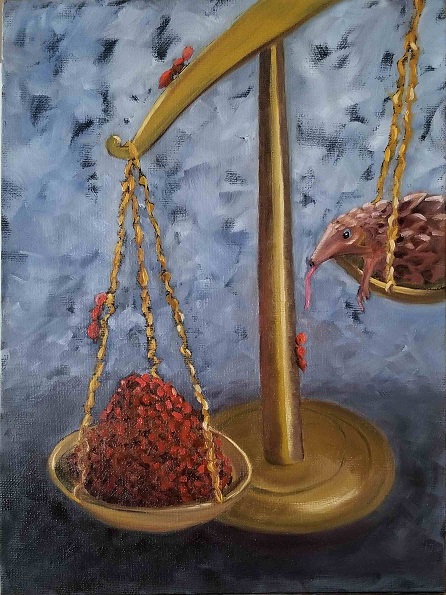
Humans have scales too, but only artificial ones, often used for weighing things that have “market value” – such as pangolin scales. In the gigantically top-heavy artificial monster called “the economy” by its human constructors, pangolin scales far outweigh the lives of pangolins, just as “market value” outweighs the value of life itself, including human life.
Pam Jackson has caught the whole strange scenario in a small painting:
Scales
This has a special meaning on Earth Day 2020, as it’s been suggested that the pangolin might have been a carrier of the virus that jumped to humans to cause the COVID-19 pandemic. The pangolin – poached, trafficked and endangered – is as innocent as the virus itself. If anyone is to blame for the pandemic, it is the humans who “make a living” from an extractive “economy” which is destructive, on an overwhelming scale, to other players in the biosphere. The pandemic is just one symptom of the busy monster in self-destruct mode.
Earth Day should redirect our attention to the natural economy, the economy of the biosphere. As if our lives depended on it – for in truth they do, just like the lives of pangolins, ants and viruses.
If i may shamelessly lift a few lines from the last rites of the Bokononist faith:
God made mud. God said to some of the mud, ‘Sit up!’ ‘See all I’ve made,’ said God, ‘the hills, the sea, the sky, the stars.’ And I was some of the mud that got to sit up and look around. Lucky me, lucky mud.
The mud of the 21st Century had truly wonderful means of looking around. If you never heard of the Bokononist faith, for instance, you could just “google” it and read all about it. Or type the keywords into some other search engine, if you didn’t trust Google’s algorithms to properly rank the results.
You didn’t have to fly anywhere to witness nature’s most amazing events. The BBC Earth crews did the flying, and the patiently waiting for the wildlife to do something interesting, so you could see it all in high-def, time-lapse and slow motion. You could even see a picture of the supermassive black hole at the centre of a distant galaxy, taken with a radiotelescope array the size of the Earth.
Meanwhile, other species of mud living on the same planet were swallowed up in mass extinction – the sixth in the planet’s history, but the first caused by a single species. That peculiar form of mud even had the means to look into its own past and see where it went wrong, and what a more sensible species could do on behalf of all mudkind. It had the means to wonder whether it would ever wake up from its busy, busy sleepwalk.
William Rees, co-inventor of the ecological footprint concept, recently published an article entitled ‘Don’t call me a pessimist on climate change, I am a realist.’ He outlines all the reasons why it is unlikely that humanity will achieve the transition to a just, healthy and sustainable way of occupying our planet. I’m inclined to agree with him on that. So i hope readers don’t think i’m an optimist on climate change just because i’m writing about ‘the transition’ and doing what little i can to further it. I’m not an optimist on living forever, either, but that only encourages me to live more deeply the little time i have.
The same applies to human civilization, as far as i’m concerned. If we are in the process of destroying ourselves, i’d really like to understand what it is about human-nature relations that pushes us in that direction. If we are in the process of making the transition to a civilization that respects the nature of ecosystems, i’d like to understand that too. Or at least contribute to somebody else’s understanding by reporting on our local experiments.
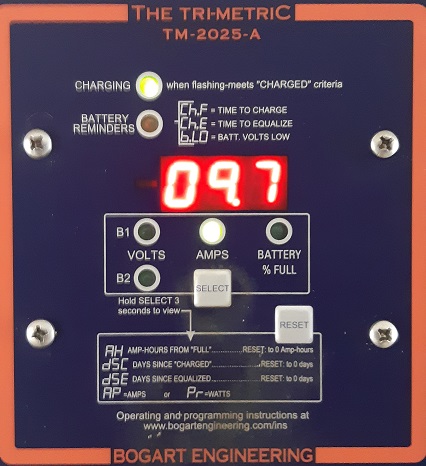
This meter in our kitchen is how we keep track of our solar energy supply. This Monday morning at 11 a.m. we have 9.7 amps more coming in than we are using.
One of those is our Chevy Bolt EV. Electric cars face special challenges in winter, because cold batteries don’t operate as efficiently. We do have an enclosed garage, but it’s not heated. The manual for ours recommends keeping it plugged in when temperatures fall below freezing. We can’t do that because we’re off the power grid and keeping the car plugged in would very quickly drain the batteries that power the whole house. To give you a rough idea, we need about 5 kilowatt-hours per day to power the household – more in the November-to-February stretch because the nights are longer. On an uncloudy day we can draw that much from the sun in 3 hours or less; but uncloudy days are rare this time of year, and 5 kwh will only power the car for about half an hour’s driving.
Of course we can’t just let the car sit unused for weeks at a time either. Since the cold weather started, Pam has been out driving three or four times a week. One weekly trip includes a charging session using the Level 2 charger we installed at our on-grid place in Little Current (15 km from home). She’s found that we can save energy by using the heated driver’s seat and steering wheel rather than heating the whole interior of the car. Of course we need the windshield defroster occasionally – but not very often (unless there’s too much conversation going on among passengers and driver!). Anyway, the risks of relying on an EV in winter are greatly outweighed by the benefits of low maintenance, zero emissions and very low “fuel” costs. We’ll see what happens when the temperature drops to -25 C.
Remembrance Day is a good time to honor those who sacrificed so much in those 20th-century wars. It’s also a good time to reflect on our national and personal contributions to the 21st-century war against global heating.
Canada is lagging behind most other G20 countries in this respect, according to the latest Brown to Green Report from the Climate Transparency network. Part of the purpose of this blog is to help subscribers keep track of how the “Brown to Green” transition is going on the planetary scale – but in this post i’d like to focus more on our own household.
I should mention first that in my personal approach to “the transition,” i’m not trying to change the world. I am simply recognizing that the world is changing, that the impact of human actions on the ecosystem is increasing rapidly, and that my own actions affect that impact. So i am changing the world whether i like it or not. The fact that our household choices are too small to register on the global scale makes no difference on the psychological or spiritual level, if i may call it that. The life of the spirit is its presence to the moment we are living, and that moment is independent of scale. The Big Bang happened yesterday, and i started writing this paragraph eons ago. The time is now, as always.
So today i’m writing about propane, the one fossil fuel we rely on directly here at gnusystems. It’s relatively clean as fossil fuels go, but burning it still emits greenhouse gases, so we try to minimize our use of it. Our main year-round use is cooking. We made that choice because using electrical heating elements to cook is not practical for an off-grid solar-powered house, and cooking with a woodstove is not practical either for our situation. We do heat the house with a woodstove, but ours isn’t suitable for cooking.
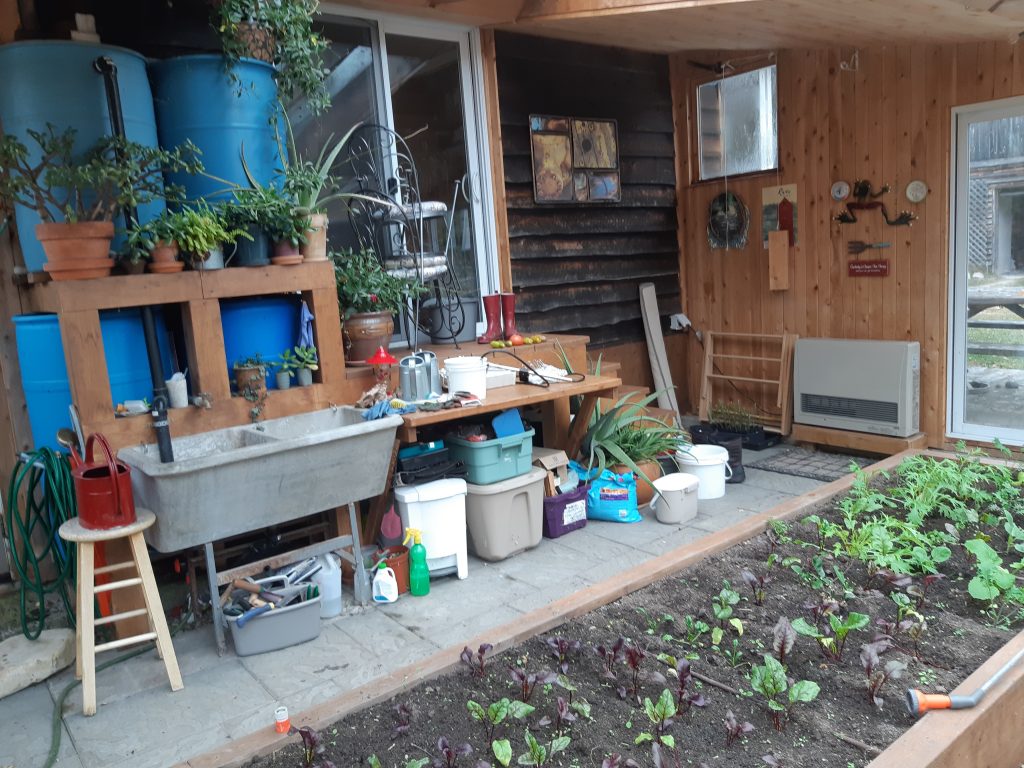
Now that we are entering the darkest and coldest part of the year, we start using much more propane. We use a propane wall furnace to keep the plants in our greenhouse from freezing. In the picture, you can see it on the right, next to the sliding door to the outside. I just plugged it in today (it uses electrical power to light the flame and run the fan) because it was -10° C. outside this morning. But i’m hoping that this year i won’t have to leave it plugged in all winter.
We have it at the lowest possible setting, which is 5°, but when it’s running it actually keeps the temperature in there at 10°. But since the greenhouse is attached to our main house, there should be days, even in winter, when the added heat from the sun is enough to keep it above freezing. So i’m experimenting with shutting off that heater on some days, in order to reduce the amount of propane we use.
Our other main use of propane in winter is to fuel the generator which charges up our batteries on days when there’s not enough sun to do it. We’ve also taken steps to reduce propane consumption there too, by adding more solar panels this fall and increasing our battery capacity a couple of years ago. The more power we can get directly from the sun, and the more of it we can store, the less we have to rely on fossil fuels. We’ll see how these experiments go.
I don’t want to leave the impression that keeping track of our household energy consumption is an onerous chore, or a “sacrifice” we are making. On the contrary, knowing intimately where our food, water, energy and connectivity is coming from is one of the best features of living so far from the city. It’s our idea of a good time, infinitely more than flying down to Rio or the south of France for the winter. Of course we love the peace and quiet too …
Next time i’ll report on how our electric car is handling the onset of winter (another experiment in eco-living).
Canadian businessman Jim Balsillie was among those who addressed the Committee about major Silicon Valley firms and the way they exploit customers: “The current business model is the root cause of the problems you are trying to address. Its toxicity is unrelenting. It is not a coding glitch that a legal patch will fix. Data at the micro-personal level gives technology unprecedented power and that’s why data is not the new oil — it’s the new plutonium.”
A transition to greater climate justice will depend on reining in the political power of Big Oil, but it may also require reining in the power of Big Data.